Healthy Breakfast Ideas: 5 Recipes That Actually Keep You Full Until Lunch
Most “healthy breakfast ideas” lists fail at the same point: they tell you what to eat, but not why it works. A bowl of fruit looks healthy and leaves you hungry by 10 a.m. A pastry with coffee is fast and leaves you worse. The difference between a breakfast that carries you to lunch and one that does not is not willpower — it is structure. A breakfast with protein, fibre and a little healthy fat digests slowly and keeps you full. A breakfast built on fast carbohydrate alone burns through in an hour.
Every idea below passes that test. Each takes 20 minutes or less, uses ordinary supermarket ingredients, and follows the same three-part formula. Learn it once and you can build breakfast from whatever is in the fridge. Three recipes are written out in full; two more need no recipe at all.
Note: this article is general food information, not medical advice. If you manage diabetes or another condition affected by what you eat, speak to your doctor or a registered dietitian before changing your diet.
The three-part formula: protein + fibre + healthy fat
Think of breakfast as three slots to fill, not a single dish to choose. When all three are filled, the meal works. When one is missing, you feel it within the hour.
Protein is what keeps you full. Eggs, Greek yogurt, cottage cheese, nuts, seeds and smoked salmon all count. Aim for roughly a palm-sized portion — two eggs, or a small pot of Greek yogurt.
Fibre slows everything down. Oats, wholegrain bread, fruit with its skin on, chia seeds and vegetables are the easy sources. Fibre is also what most breakfasts are missing entirely.
Healthy fat is the flavour and the staying power: avocado, nuts, seeds, olive oil, nut butter. A little goes a long way — a tablespoon of peanut butter or half an avocado is enough.
Here is the formula in practice: toast (fibre) + eggs (protein) + avocado (healthy fat). Or oats (fibre) + yogurt (protein) + walnuts (healthy fat). Or a smoothie with berries (fibre), Greek yogurt (protein) and a spoonful of peanut butter (healthy fat). Same shape, different breakfast every day. The Harvard T.H. Chan School of Public Health notes that whole grains — oats, whole wheat, brown rice — are a far better source of fibre and nutrients than refined grains, and that choosing them is one of the simplest upgrades a meal can get Harvard T.H. Chan School of Public Health.
Recipe 1: Overnight oats with berries and walnuts (5 minutes, made the night before)
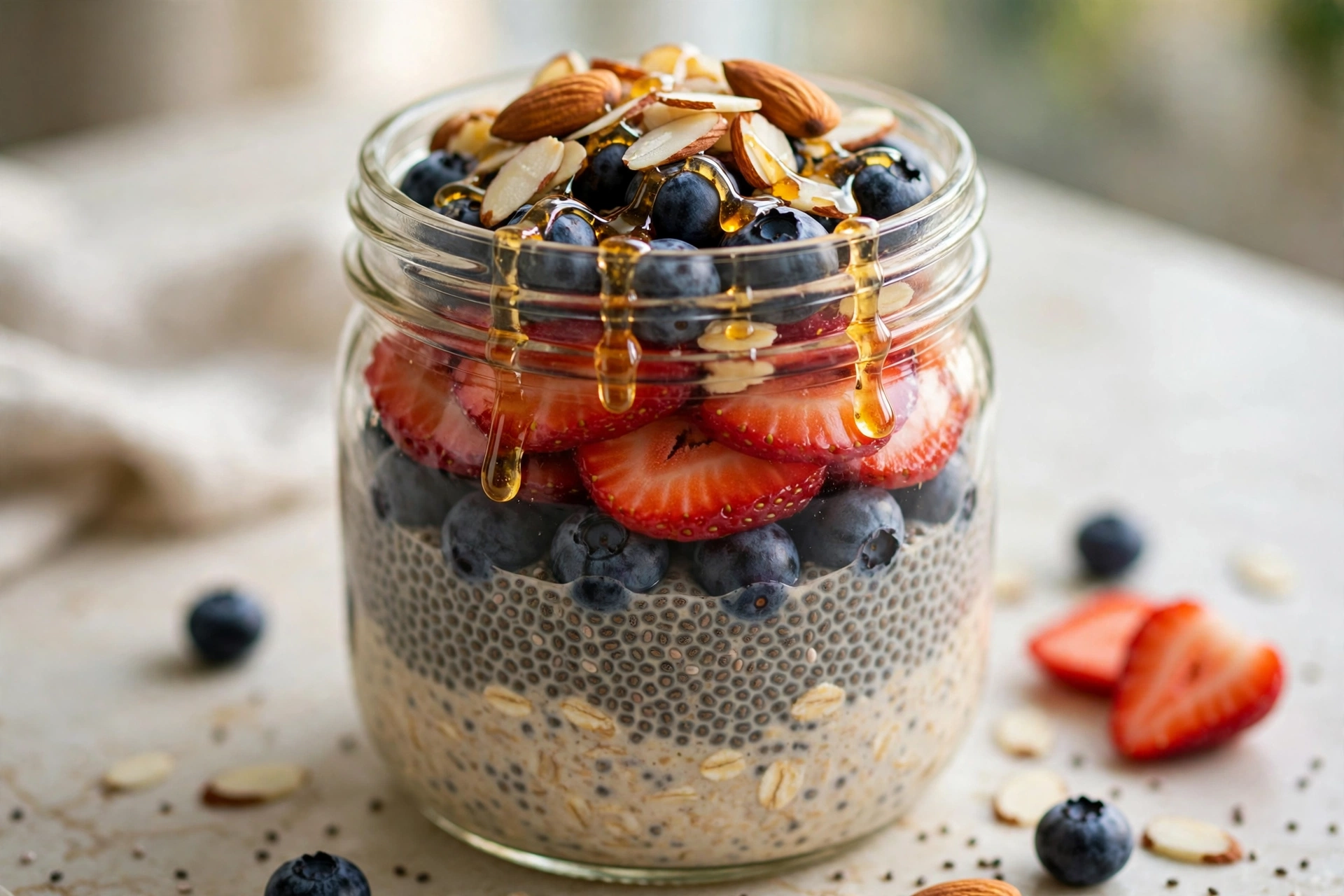
Overnight oats are the highest-return breakfast on this list: five minutes of work the night before, zero work in the morning, and a breakfast that genuinely keeps you full. The oats soften in the milk overnight, the chia seeds thicken everything, and the berries and nuts add fibre and healthy fat.
Prep: 5 minutes | Chill: overnight (at least 4 hours) | Serves: 1
Ingredients
- 50 g rolled oats
- 1 tablespoon chia seeds
- 120 ml milk (any kind)
- 100 g Greek yogurt
- A handful of blueberries and sliced strawberries
- 1 tablespoon chopped walnuts or almonds
- 1 teaspoon honey or maple syrup (optional)
- A pinch of cinnamon
Method
- Stir the oats, chia seeds, milk, yogurt and cinnamon together in a jar or small bowl.
- Cover and refrigerate overnight, or for at least 4 hours.
- In the morning, top with the berries, nuts and honey. Eat cold, straight from the fridge.
Make it yours: swap the berries for sliced banana or grated apple, use peanut butter instead of nuts, or add a spoonful of cocoa powder for a chocolate version. The base never changes — oats, chia, milk, yogurt. For another make-ahead breakfast that uses the same chia-seed trick, see our chia seed pudding recipe.
Recipe 2: Veggie omelette with spinach and mushrooms (10 minutes)
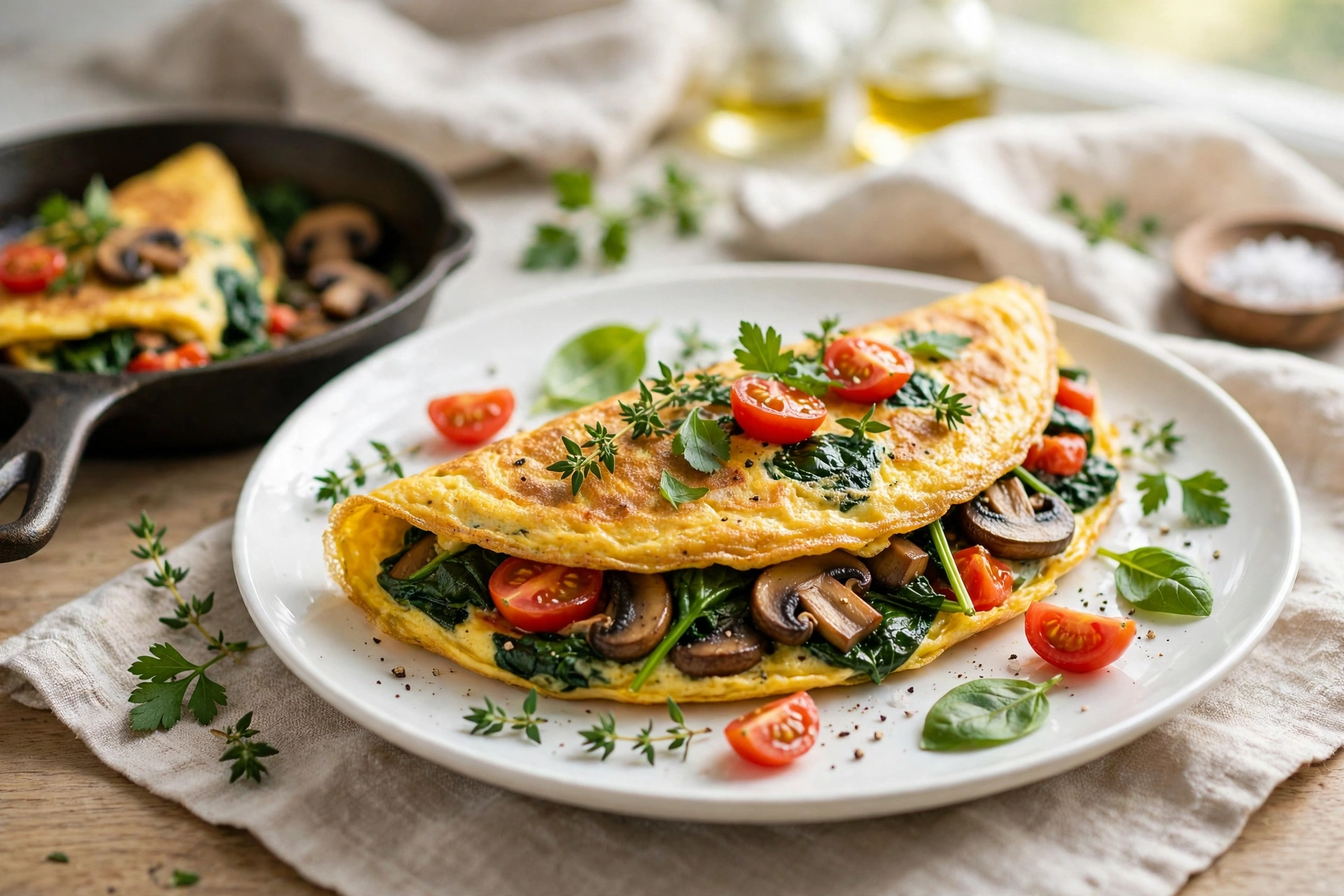
An omelette is the fastest hot breakfast there is, and it is also the most forgiving — whatever vegetables are in the fridge will work. Eggs supply the protein, the vegetables supply fibre, and a drizzle of olive oil or a few slices of avocado supply the healthy fat. Eat it with a slice of wholegrain toast and the formula is complete.
Prep: 3 minutes | Cook: 7 minutes | Serves: 1
Ingredients
- 2 eggs, beaten with a pinch of salt
- A handful of spinach
- 3–4 mushrooms, sliced
- 4 cherry tomatoes, halved
- 1 teaspoon olive oil or butter
- 1 slice wholegrain toast, to serve
- Black pepper and fresh herbs
Method
- Heat the oil in a small non-stick pan over medium heat. Cook the mushrooms for 2 minutes, then add the spinach and tomatoes and cook for 1 minute more, until the spinach wilts.
- Pour in the beaten eggs and tilt the pan so they cover the base. Cook gently for 2–3 minutes, lifting the edges with a spatula so the uncooked egg runs underneath.
- When the top is just set, fold the omelette in half and slide it onto a plate.
- Season with black pepper and herbs, and serve with the toast.
Make it yours: add feta, smoked salmon, peppers or courgette — the method stays the same. If you want more low-carbohydrate breakfast options built on the same egg-and-vegetable base, our low carb breakfast ideas guide has a full week of them.
Recipe 3: Avocado toast with a poached egg (10 minutes)
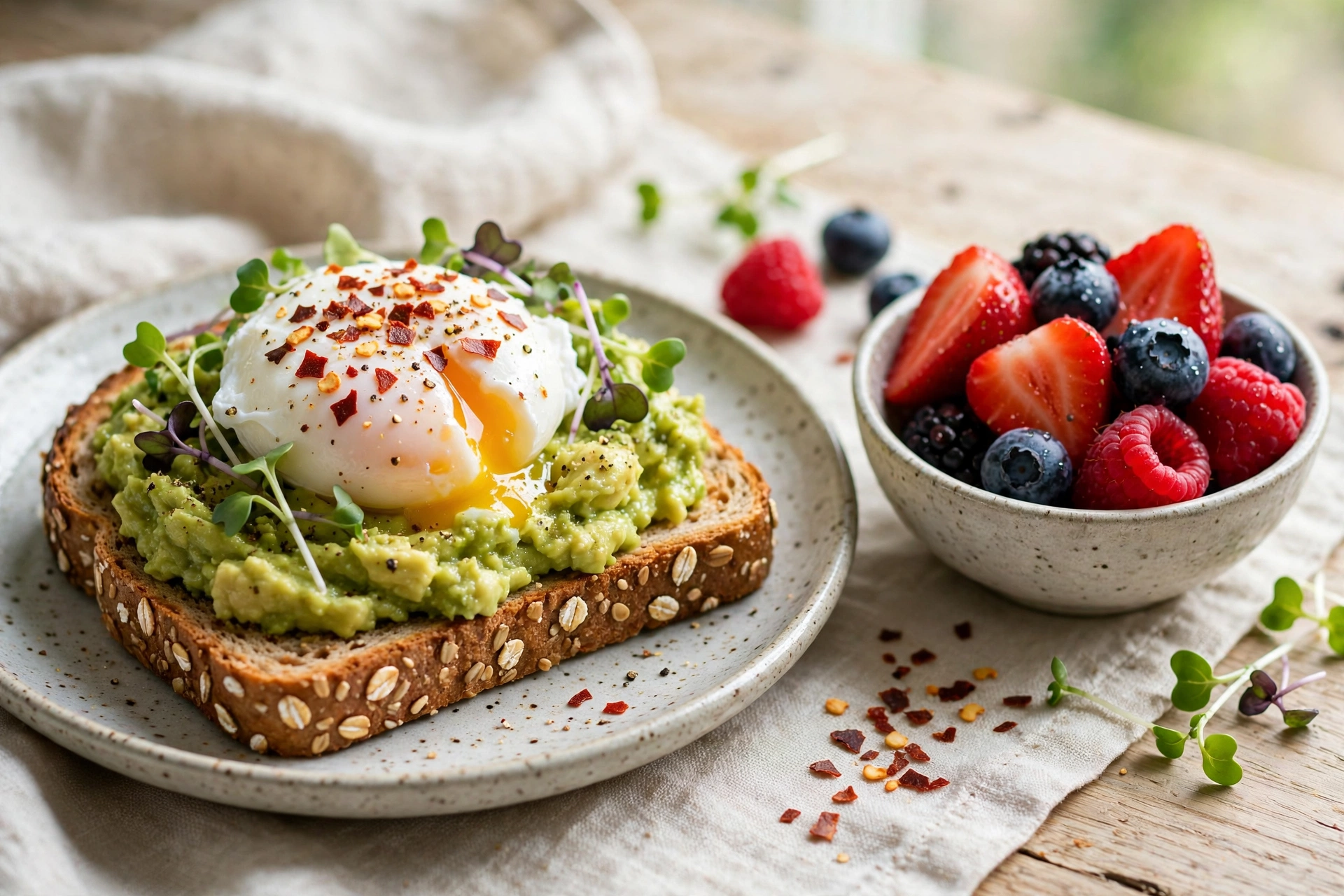
Avocado toast gets mocked as a cliché, but nutritionally it is hard to fault: wholegrain bread for fibre, avocado for healthy fat, and a poached egg for protein. The trick is to keep the toppings honest — avocado and egg, not a pile of bacon and cheese.
Prep: 3 minutes | Cook: 7 minutes | Serves: 1
Ingredients
- 1 slice wholegrain or sourdough bread
- 1/2 ripe avocado
- 1 egg
- 1 teaspoon white vinegar (for poaching)
- A pinch of chilli flakes
- Salt, black pepper and lemon juice
Method
- Toast the bread until crisp — it needs to hold up under the avocado.
- Simmer a small pan of water with the vinegar. Swirl the water, crack the egg into the centre, and poach for 3 minutes for a runny yolk.
- Mash the avocado with a squeeze of lemon, salt and pepper, and spread it thickly on the toast.
- Lift the egg out with a slotted spoon, rest it on the avocado, and finish with chilli flakes.
Make it yours: a fried egg works just as well, and a smear of cottage cheese under the avocado adds even more protein. If poaching feels fiddly on a weekday, scramble the egg instead — the formula does not care how the egg is cooked.
Two more ideas that need no recipe
Greek yogurt bowl. A pot of Greek yogurt, a handful of berries, a spoonful of oats or granola and a few walnuts. Protein, fibre, healthy fat — assembled in two minutes, eaten at your desk. Buy plain yogurt and add your own fruit; flavoured yogurts are often sweetened enough to undo the point.
Peanut butter banana smoothie. One banana, a large spoonful of peanut butter, a glass of milk and a handful of oats, blended. It tastes like a milkshake and keeps you full for hours — the oats are what make the difference between a drink and a breakfast.
Three breakfast mistakes that undo the good work
1. Drinking your breakfast. A glass of orange juice has about as much sugar as a soft drink and none of the fibre of the fruit it came from. Eat the orange; drink water. The NHS advises keeping even unsweetened fruit juice to one small glass a day, and ideally taking it with a meal NHS, Water, Drinks and Your Health.
2. The cereal trap. Many breakfast cereals marketed as healthy are mostly refined carbohydrate with added sugar. Check the label: if sugar is in the first three ingredients, it is dessert, not breakfast. Plain oats, or a cereal with wholegrain listed first and less than 5 g of sugar per serving, are the safer choice.
3. Skipping the protein. Toast and jam, a croissant, or a bowl of fruit are all carbohydrate on their own. Add one protein source — an egg, yogurt, nuts — and the same breakfast lasts twice as long. This single change does more for your mornings than any superfood.
Frequently asked questions
What is the healthiest breakfast?
There is no single healthiest breakfast, but the best pattern is consistent: protein, fibre and healthy fat together. Overnight oats with yogurt and nuts, eggs with vegetables and wholegrain toast, or a Greek yogurt bowl all fit that pattern and keep you full until lunch.
What should I eat for breakfast to stay full until lunch?
Build the meal around protein — eggs, Greek yogurt or cottage cheese — and add fibre from oats, wholegrain bread or fruit. A breakfast of toast and jam alone will leave you hungry within an hour; the same toast with eggs and avocado will not.
Are overnight oats actually healthy?
Yes, when made with plain oats, milk and yogurt and topped with fruit and nuts. They are high in fibre and keep you full for hours. They become less healthy when made with sweetened yogurt, syrup and chocolate — keep the sweetener to a teaspoon or skip it.
Can I prep healthy breakfasts for the whole week?
Mostly yes. Overnight oats keep 3–4 days in the fridge, hard-boiled eggs keep up to a week, and smoothie ingredients can be portioned into freezer bags. Avocado toast and omelettes are best made fresh, but they take ten minutes.
Is it bad to skip breakfast?
Skipping breakfast is not harmful for most healthy adults, but it often leads to a very large, very sugary late-morning snack. If you skip breakfast and feel fine and eat well at lunch, that is OK. If you skip it and then overeat at 11 a.m., a small protein-rich breakfast will usually help.
Final word
Healthy breakfast ideas are not a list to memorise — they are a formula to learn. Protein, fibre, healthy fat: fill all three slots and almost any breakfast works. Start with the overnight oats, keep eggs and yogurt in the fridge, and prep on Sunday so the weekday version of you never has to think. The mornings will take care of themselves.
Source: Harvard T.H. Chan School of Public Health, Whole Grains
Source: NHS, 8 Tips for Healthy Eating
Related Posts

How to Make Vegetable Stock (From Fresh Veg or Kitchen Scraps)
Every good soup starts somewhere, and for most of them that somewhere is a pot of stock. The funny thing…

Bang Bang Shrimp Recipe: Crispy Shrimp, Creamy-Spicy Sauce at Home
Bang Bang Shrimp Recipe: Crispy Shrimp, Creamy-Spicy Sauce at Home This bang bang shrimp recipe is built around one fact:…
Sous Vide Steak Recipe: Garlic-Herb Butter Steak, Cooked to the Degree
Sous Vide Steak Recipe: Garlic-Herb Butter Steak, Cooked to the Degree A sous vide steak recipe solves the one problem…