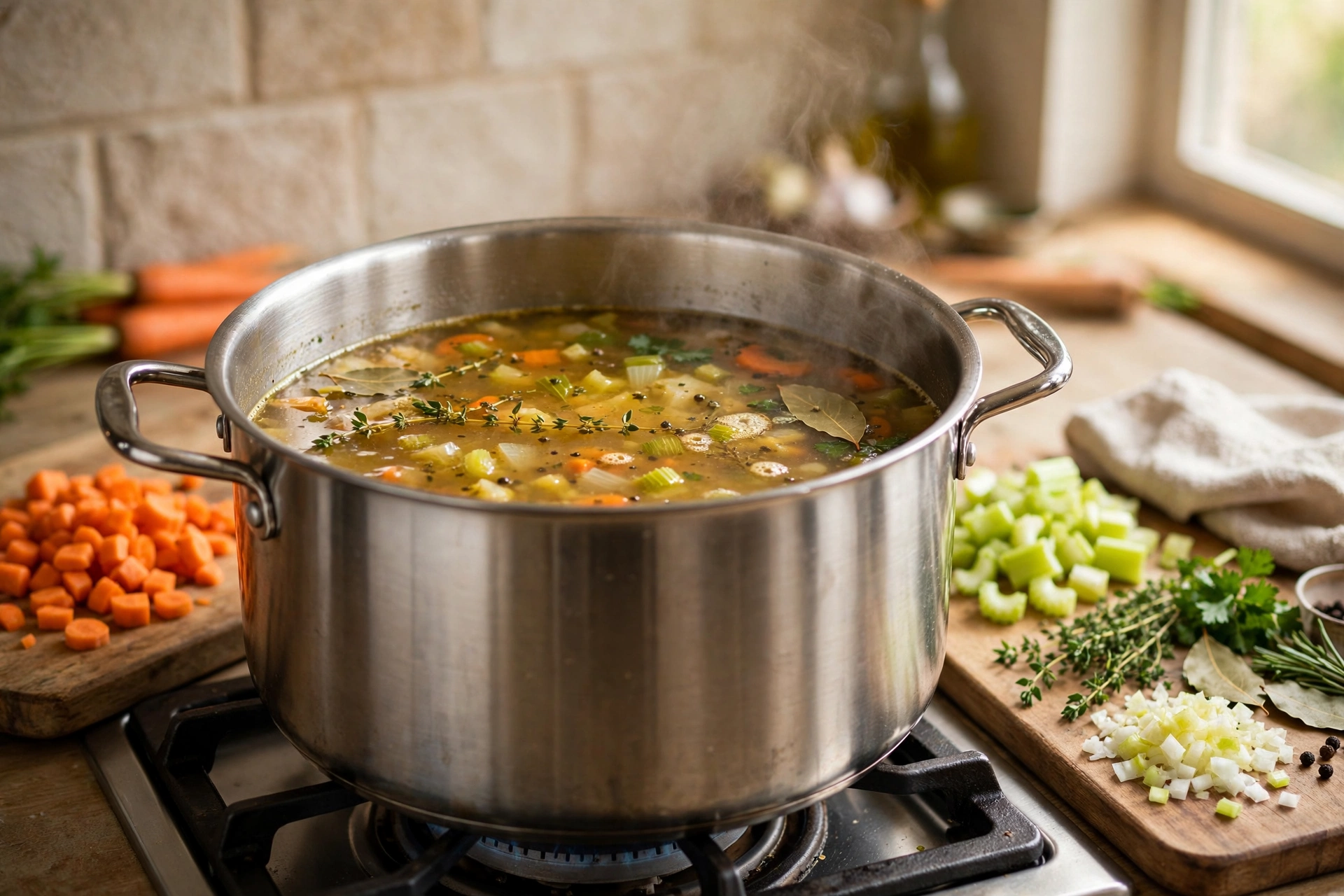
Every good soup starts somewhere, and for most of them that somewhere is a pot of stock. The funny thing is that the best vegetable stock costs almost nothing: it is made from the parts of vegetables you were about to throw away. Onion ends, carrot peels, celery tops, mushroom stems — simmered gently for under an hour, they turn into a golden, savoury liquid that makes everything it touches taste better. As a result, a good stock is the foundation of a good soup.
Learning how to make vegetable stock at home is one of those small kitchen skills that quietly upgrades your cooking for years. It beats a cube or a carton on flavour, it lets you control the salt, and it turns a bin-bound bag of scraps into the base of next week’s meals. Here is the full method, plus three variations and the storage rules that keep it safe. In fact, it takes about an hour, and most of that time is hands-off.
Why Homemade Stock Beats a Cube
Shop-bought stock has its place — it is fast and consistent. But homemade wins on three counts: For example, a cube cannot match the clean flavour of fresh stock.
- Flavour. Fresh stock tastes clean and bright, like the vegetables it came from. Cubes and powders lean salty and one-dimensional by comparison, and they often carry a slightly chemical aftertaste.
- Salt control. You decide how much salt goes in — or none at all, which matters if you are cooking for someone watching their sodium, or reducing a sauce where the salt would concentrate.
- Zero waste. The scraps version of this recipe costs nothing at all. It is the same vegetables, the same pot, the same hour — just with the bits you already paid for.
The Base Recipe
This is the everyday version: balanced, golden, and good in almost anything. It makes about 2 litres (roughly 8 cups). Above all, it is simple enough to make on a weeknight.
Prep time: 15 minutes · Cook time: 45 minutes · Total: 1 hour · Yield: about 2 litres · Makes: enough for a big pot of soup plus extra for the freezer.
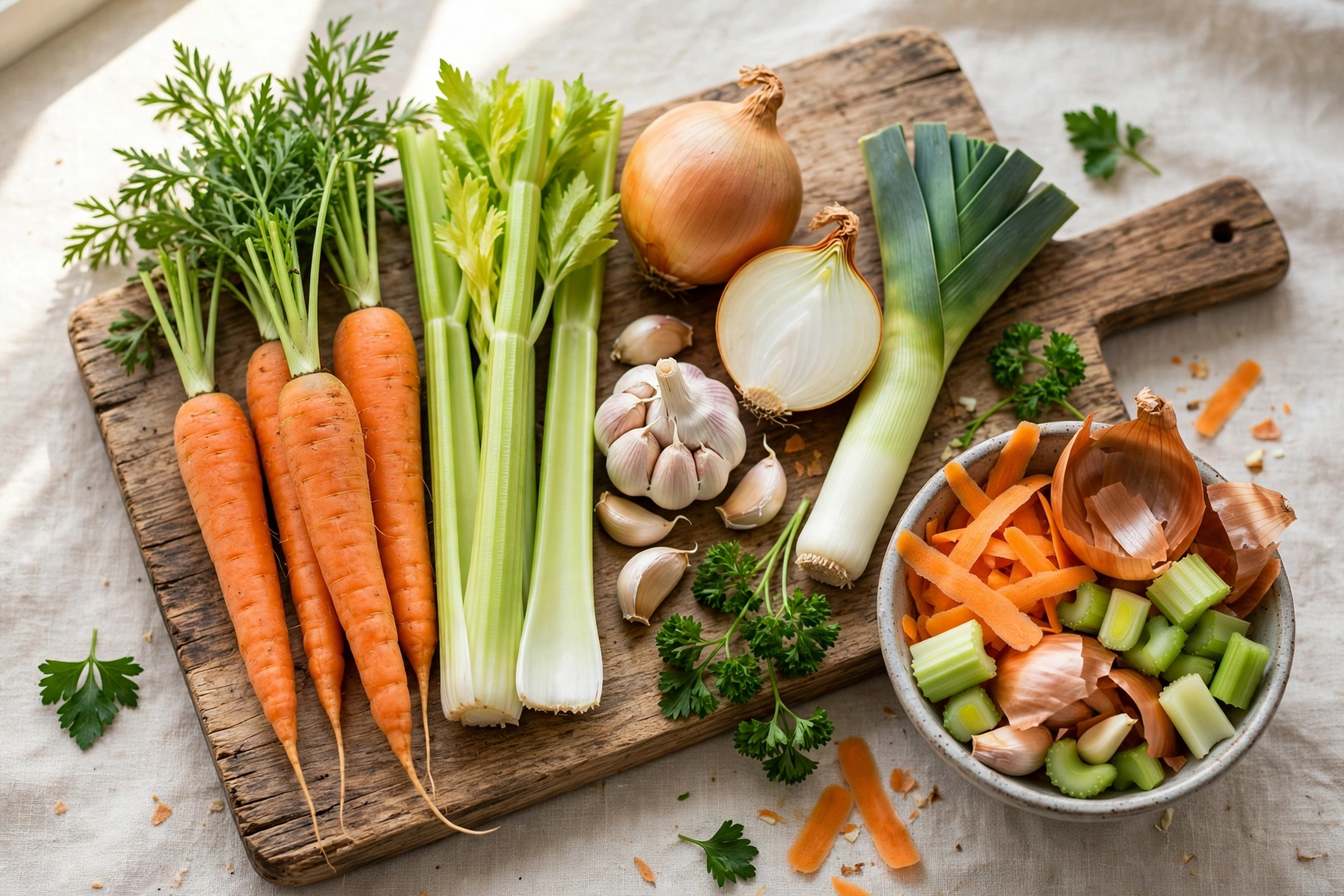
How to Make Vegetable Stock: Ingredients
- 2 onions, quartered (skins on is fine — they add colour)
- 3 carrots, roughly chopped
- 3 celery stalks, roughly chopped
- 1 leek, white and light-green parts, sliced and rinsed
- 4 garlic cloves, smashed
- 1 small handful of parsley stems (or a few sprigs)
- 1 bay leaf
- 6–8 whole black peppercorns
- 2.5 litres (about 10 cups) cold water
- Salt, to taste — or none, if you prefer to season later
How to Make Vegetable Stock: Method
- Wash and chop. Scrub the vegetables clean. There is no need to peel the carrots or onions — just trim off any damaged ends. Rough chopping is fine; the pieces will be strained out.
- Combine. Put everything except the salt into a large stock pot and cover with the cold water. Starting with cold water helps draw flavour out of the vegetables gradually.
- Bring up slowly. Heat over medium-high until the water just starts to bubble, then turn the heat right down. You want the gentlest simmer — a few lazy bubbles breaking the surface, not a rolling boil.
- Skim. In the first 10 minutes, a little foam may rise. Skim it off with a spoon for a clearer stock.
- Simmer 45 minutes. Leave the lid slightly ajar and simmer gently. Longer is not better here — past an hour, vegetables start to give up bitter notes.
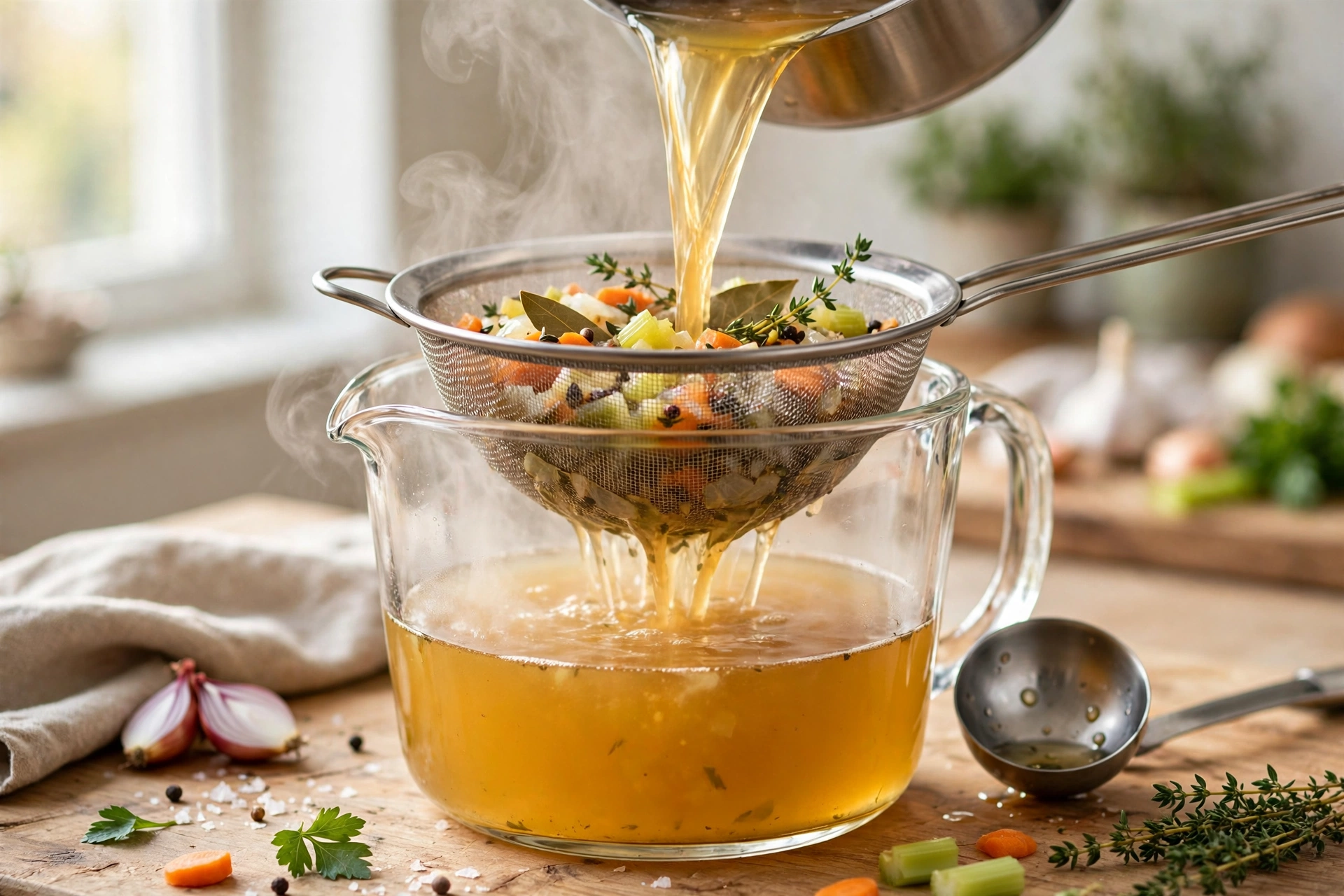
- Strain. Pour through a fine mesh strainer into a large bowl or jug. Do not press the vegetables down hard; squeezing them clouds the stock.
- Season (or don’t). Taste and add salt now if you like, or leave it unsalted and season each dish as you cook. Unsalted stock is more flexible.
That is it. One pot, one hour, and your freezer suddenly has the makings of a dozen meals. In short, one batch covers a dozen meals.
Three Variations Worth Trying
Once you know the base, the variations are easy — each one starts from the same method with a few swaps. For instance, the scrap-bag version costs nothing at all.
1. The Scrap-Bag Stock (Zero Waste): Keep a bag in the freezer and add clean vegetable trimmings as you cook: onion ends and skins, carrot peels and tops, celery ends, leek greens, mushroom stems, herb stems, the woody ends of asparagus. When the bag is full, tip it into the pot, add water, garlic, bay and peppercorns, and simmer exactly as above. It is the same stock, for free.
What to leave out of the scrap bag: potato peels (they cloud the stock and add starch), cabbage, broccoli and cauliflower (they turn bitter and sulphurous over a long simmer), and beetroot (it will dye everything pink). Strong-flavoured scraps are best kept out — save them for the compost. As a result, your stock stays clear and sweet.
More Ways to Make Vegetable Stock
2. Roasted Vegetable Stock (Deep and Rich): For a darker, more intense stock, roast the vegetables first. Toss the onions, carrots, celery and a head of garlic (cut in half) with a little oil and roast at 200°C / 400°F for 25–30 minutes until the edges caramelise. Then make the stock as usual, scraping the browned bits from the tray into the pot. This is the version to reach for when the stock is the star — a mushroom risotto, a French onion soup, or a gravy. For example, a hot oven brings out a deep, caramelised flavour.
3. Asian-Style Stock (Light and Aromatic): Swap the bay leaf and peppercorns for a thumb of ginger, a stalk of lemongrass (bruised), and a couple of spring onions. Simmer for 30–40 minutes instead of 45 — the aromatics are delicate and turn bitter if pushed. This light, fragrant stock is the base for noodle soups, ramen-style broths and steamed dumplings. Above all, keep the simmer gentle so the aromatics stay bright.
What Goes In — and What Stays Out
Good in stock: Onion, carrot, celery, leek; Garlic, mushroom stems, parsnip; Parsley stems, bay leaf, peppercorns; Tomato (a little, for sweetness); Corn cobs, pea pods, herb stems.
Keep out: Potato peels (cloudy, starchy); Cabbage, broccoli, cauliflower (bitter); Beetroot (dyes everything pink); Chillies (overpowering); Anything mouldy or rotten.
The rule is simple: if it smells good raw and is not bitter, starchy or overpowering, it probably belongs in the pot. In short, trust your nose when choosing what goes in.
How to Store Vegetable Stock Safely
Stock is a perishable food, so cool it and store it properly: For instance, shallow containers cool the stock much faster.
- Cool quickly. Divide hot stock into shallow containers so it cools fast, then refrigerate within two hours of cooking.
- Fridge: use within 3–4 days — the same window the FDA gives for soups and stews in its refrigerator and freezer storage chart.
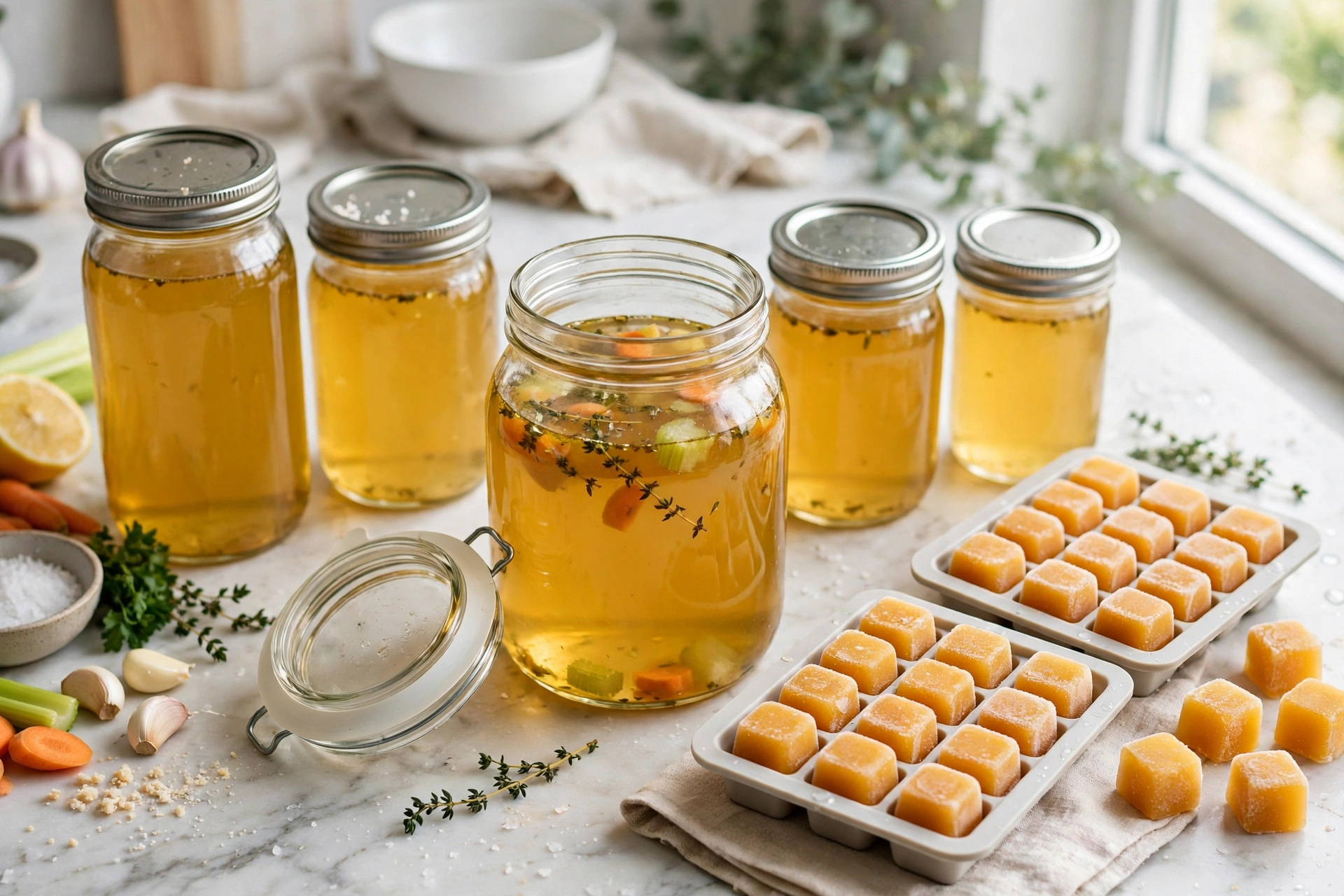
- Freezer: pour into jars (leave a gap at the top for expansion), freezer bags laid flat, or ice-cube trays for small portions. Frozen stock keeps for 2–3 months at best quality.
- Reheating: bring stock back to a rolling boil, or reheat it to 165°F / 74°C — the safe temperature the USDA gives for leftovers — before using.
- Label every container with the date. A freezer full of mystery bags is a freezer full of food nobody trusts.
Useful references: the USDA FSIS Safe Minimum Internal Temperature Chart and the FDA’s Are You Storing Food Safely? guide.
Ways to Use Your Stock
A pot of stock is a head start on a dozen dinners: In fact, one batch can carry you through a week of cooking.
- Soups — the obvious one. Our soup recipes for spring are a good place to start, and a homemade stock lifts every one of them.
- Risotto and grains — cook rice, quinoa or barley in stock instead of water and the flavour doubles for free.
- One-pot meals — a splash of stock deglazes the pan and becomes the sauce. See our one pot meals for the technique.
- Steaming and braising — steam vegetables over stock, or braise greens in it, for extra depth.
- Roasted vegetables — a little stock in the roasting tray keeps vegetables moist and adds savoury flavour; our roasted vegetables guide shows the method.
Frequently Asked Questions
How long does homemade vegetable stock last? In the fridge, 3–4 days. In the freezer, 2–3 months at best quality. Always cool it quickly, store it in clean containers, and label with the date.
Can I make vegetable stock from scraps? Yes — it is the cheapest way to make it. Collect clean trimmings (onion ends, carrot peels, celery tops, mushroom stems, herb stems) in a freezer bag until you have enough, then simmer as usual. Avoid potato peels, cabbage-family vegetables and anything mouldy.
Do I need to peel vegetables for stock? No. Scrub them clean and use them unpeeled — onion skins even add a lovely golden colour. Just trim off damaged or rotten parts.
More Answers on How to Make Vegetable Stock
Why is my vegetable stock cloudy? Usually because it boiled too hard, or because the vegetables were pressed while straining. Keep the simmer gentle and let the stock drain through the strainer on its own. A little cloudiness is harmless — it is a flavour issue, not a safety one.
Can I make vegetable stock in a slow cooker? Yes. Put everything in the slow cooker, cover with water, and cook on low for 6–8 hours or on high for 3–4 hours. Strain as usual. It is a good option if you want to set it going in the morning and come home to a finished stock.
The Takeaway
How to make vegetable stock comes down to three things: good vegetables (or clean scraps), cold water, and a gentle simmer for 45 minutes. No special equipment, no hard techniques — just a pot, an hour, and the habit of saving your trimmings. Make a batch this weekend, freeze half of it, and the next time a recipe calls for stock, you will already have the best version of it waiting in your freezer. In the end, the best stock is the one you actually make.
Storage times follow the FDA’s refrigerator and freezer storage guidance for soups and stews, and reheating temperatures follow the USDA’s safe minimum internal temperature chart for leftovers.